
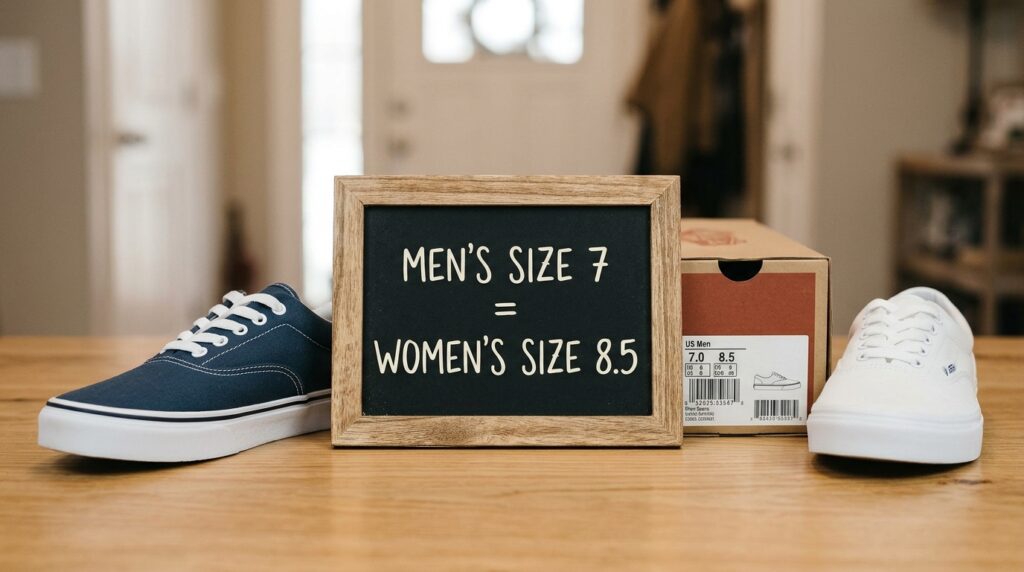

Shopping for shoes can sometimes be confusing, especially when comparing men’s and women’s shoe sizes. Whether you are shopping online, looking for a particular sneaker style, or trying to find a comfortable pair of shoes in another department, understanding shoe size conversions can make the process much easier.
One common question shoppers ask is: Men’s size 7 is what size in women’s shoes?
In most US shoe sizing systems, a men’s size 7 is approximately equivalent to a women’s size 8.5. This conversion is based on the general difference between standard men’s and women’s shoe sizing. However, the exact fit can vary depending on the footwear brand, shoe design, and width.
If you have found a pair of men’s shoes that you love but normally wear women’s footwear, there is no need to overlook them. With a little knowledge about shoe sizing, you can identify the closest equivalent and make a more confident purchasing decision.
This guide explains how men’s and women’s shoe sizes compare, how to convert a men’s size 7 into a women’s size, and what to consider when choosing shoes for everyday wear, sports, and special occasions.
1. Men’s Size 7 Is What in Women’s Shoes?
A US men’s size 7 generally converts to a US women’s size 8.5.
The standard conversion method is to add approximately 1.5 sizes to a men’s shoe size to estimate the corresponding women’s size.
For example:
- Men’s size 6 = Women’s size 7.5
- Men’s size 6.5 = Women’s size 8
- Men’s size 7 = Women’s size 8.5
- Men’s size 7.5 = Women’s size 9
- Men’s size 8 = Women’s size 9.5
- Men’s size 8.5 = Women’s size 10
- Men’s size 9 = Women’s size 10.5
- Men’s size 9.5 = Women’s size 11
- Men’s size 10 = Women’s size 11.5
These measurements provide a useful starting point when shopping across men’s and women’s footwear collections.
However, remember that shoe sizing is not completely standardized. A men’s size 7 in one brand may feel slightly different from a women’s size 8.5 in another.
2. Understanding the Difference Between Men’s and Women’s Shoe Sizes
Men’s and women’s shoes are often designed using different sizing standards. Although both categories measure foot length, their numerical sizing systems are different.
In the United States, women’s shoe sizes are generally around 1.5 sizes larger than men’s sizes for a similar foot length.
For example, someone who comfortably wears a men’s size 7 may find that a women’s size 8.5 provides a comparable length.
The difference is important because shoe labels do not always represent the same physical measurements.
Men’s Shoe Sizing
Men’s footwear generally uses a smaller numerical size for a particular foot length compared with women’s footwear.
Men’s shoes are also traditionally designed with wider proportions, although this varies between brands and individual models.
Women’s Shoe Sizing
Women’s shoes typically use a larger numerical size for approximately the same foot length.
Women’s footwear may also have different proportions, including narrower heels and different overall shapes.
However, modern footwear brands increasingly offer different widths and designs to accommodate a wider range of foot shapes.
3. Men’s to Women’s Shoe Size Conversion Chart
A conversion chart is one of the easiest ways to compare men’s and women’s footwear sizes.
The following chart provides approximate US shoe size equivalents.
| US Men’s Size | US Women’s Size |
|---|---|
| 5 | 6.5 |
| 5.5 | 7 |
| 6 | 7.5 |
| 6.5 | 8 |
| 7 | 8.5 |
| 7.5 | 9 |
| 8 | 9.5 |
| 8.5 | 10 |
| 9 | 10.5 |
| 9.5 | 11 |
| 10 | 11.5 |
| 10.5 | 12 |
| 11 | 12.5 |
| 11.5 | 13 |
| 12 | 13.5 |
This chart is particularly helpful when shopping for sneakers, casual shoes, athletic footwear, and other everyday styles.
If you are purchasing shoes from an international retailer, check whether the listed sizes follow US, UK, or European standards before ordering.
4. Does Men’s Size 7 Fit Like Women’s Size 8.5?
Generally, yes. A men’s US size 7 and a women’s US size 8.5 are considered approximate equivalents in length.
However, equivalent sizing does not necessarily mean identical comfort.
Several factors influence how a shoe feels when worn.
Foot width: Men’s shoes are often wider than standard women’s shoes. Someone with wider feet may find men’s footwear more comfortable.
Heel shape: Women’s footwear sometimes has a narrower heel design, which can affect how securely the shoe fits.
Arch support: Different shoe models provide different levels of arch support, cushioning, and stability.
Brand sizing: Manufacturers use different lasts, materials, and construction methods. Consequently, two shoes with identical size labels may fit differently.
Shoe style: Running shoes, basketball shoes, dress shoes, and casual sneakers may all have different fitting characteristics.
For these reasons, it is always helpful to check the manufacturer’s size chart and read customer reviews before purchasing.
5. How to Measure Your Feet for the Right Shoe Size
If you are unsure whether a men’s size 7 or women’s size 8.5 will fit comfortably, measuring your feet is a practical solution.
You do not need professional equipment. A piece of paper, a pencil, a ruler, and a flat surface are usually enough.
Follow these steps:
Step 1: Place Your Foot on Paper
Put a sheet of paper on a hard, flat floor. Stand on it with your heel positioned naturally against the surface.
It is better to measure your feet while standing because your body weight can slightly change your foot dimensions.
Step 2: Trace Your Foot
Use a pencil to trace around your foot carefully. Keep the pencil upright rather than angling it inward.
Step 3: Measure the Length
Measure the distance between the back of your heel and the tip of your longest toe.
Record the measurement in inches or centimeters.
Step 4: Measure Both Feet
Repeat the process for your other foot. Many people have slightly different foot measurements.
Choose your shoe size based on the larger foot to help prevent discomfort.
Step 5: Compare Your Measurements
Use the shoe manufacturer’s official size chart to identify the closest corresponding size.
Remember that foot measurements are more useful when combined with information about width and shoe design.
6. Are Men’s Shoes Wider Than Women’s Shoes?
Traditionally, men’s shoes are designed with wider proportions than standard women’s shoes.
However, this is not a universal rule. Modern footwear manufacturers produce shoes in different widths to accommodate various foot shapes.
Common width classifications include:
- Narrow: Designed for feet that need less overall shoe width.
- Medium: Standard width for many everyday footwear styles.
- Wide: Provides additional room around the forefoot.
- Extra wide: Designed for feet that require more space.
In many US sizing systems, men’s medium width is designated D, while women’s medium width is generally B.
This distinction is important when converting men’s size 7 into women’s size 8.5.
Even if the length is approximately equivalent, the width may feel different.
For example, someone with a wider foot may prefer a men’s size 7 sneaker instead of a women’s size 8.5 sneaker.
On the other hand, someone with narrow feet may find a standard men’s shoe slightly loose.
7. Can Women Wear Men’s Size 7 Shoes?
Absolutely. Women can wear men’s size 7 shoes if the footwear provides a comfortable and secure fit.
Shoe sizing categories are primarily intended to help shoppers find suitable measurements. They do not determine who can wear a particular style.
Many women purchase men’s sneakers because they prefer the available colors, designs, materials, or wider fit.
Men’s footwear can also provide additional options for people who struggle to find comfortable shoes in standard women’s sizes.
Popular choices include:
- Running shoes
- Walking sneakers
- Basketball shoes
- Casual trainers
- Canvas sneakers
- Hiking footwear
- Everyday athletic shoes
When choosing men’s footwear, pay attention to the shoe’s actual measurements rather than relying exclusively on the number printed on its label.
8. Popular Shoe Brands and Size Conversion
Different footwear brands may have slightly different sizing standards. Therefore, a men’s size 7 does not always feel exactly like a women’s size 8.5 across every collection.
Here are some considerations when shopping for popular footwear brands.
Nike
Nike offers a wide selection of men’s and women’s athletic shoes, including running sneakers, lifestyle footwear, and training shoes.
When comparing Nike sizes, consult the specific product’s size chart. Consider foot length and width rather than assuming that every model fits identically.
Adidas
Adidas produces footwear for sports, training, and everyday fashion.
Its men’s and women’s shoe collections may have different shapes and proportions. Checking the brand’s measurement guide can help you select the correct equivalent.
New Balance
New Balance is known for offering different shoe widths across selected collections.
This can be particularly helpful for shoppers who need additional space in the forefoot or a more precise fit.
Converse
Converse sneakers are popular for their simple styling and versatile designs.
However, different Converse models can fit differently. Always review the specific model’s sizing recommendations before choosing a men’s or women’s equivalent.
Puma
Puma offers athletic and casual footwear in various designs.
Its size guides can help shoppers compare men’s and women’s measurements when purchasing sneakers online.
The most important consideration is that brand-specific sizing recommendations should take priority over general conversion charts.
9. Men’s Size 7 to Women’s Size 8.5 for Different Shoe Types
Although the general conversion remains approximately the same, different footwear styles can affect the final fit.
Running Shoes
Running shoes should provide sufficient room for your toes to move comfortably.
If you are converting a men’s size 7 into a women’s size 8.5, check the toe box, heel stability, and overall cushioning.
A proper running shoe should feel secure without squeezing your feet.
Walking Shoes
Walking shoes should offer comfort, flexibility, and suitable support.
Consider the shoe’s midsole cushioning and overall construction, especially if you plan to wear it throughout the day.
Basketball Shoes
Basketball footwear often has a more structured design to provide support during quick movements.
Pay particular attention to ankle comfort, foot stability, and the width of the shoe.
Casual Sneakers
Casual sneakers are often easier to compare across men’s and women’s collections.
Nevertheless, the material and shape can influence the fit. Try them on with the type of socks you normally wear.
Dress Shoes
Dress shoes can have a different fit from athletic footwear.
A men’s size 7 may not feel exactly like a women’s size 8.5 in a formal shoe because the toe shape, heel construction, and overall design can vary significantly.
10. Common Mistakes When Converting Men’s and Women’s Shoe Sizes
Understanding the conversion formula is helpful, but several common mistakes can lead to purchasing the wrong size.
Mistake 1: Assuming All Brands Fit the Same
Not every manufacturer follows identical fitting standards. A shoe that fits perfectly in one brand may feel tight or loose in another.
Mistake 2: Ignoring Foot Width
Foot length is only one part of a comfortable fit. Width is equally important, particularly when switching between men’s and women’s footwear.
Mistake 3: Confusing US and UK Sizing
US and UK shoe sizes use different numerical systems.
A men’s US size 7 should not automatically be treated as a men’s UK size 7.
Always confirm the sizing system before placing an order.
Mistake 4: Ordering Without Checking the Size Chart
A general conversion chart is useful, but the manufacturer’s official chart is usually a better reference.
Mistake 5: Forgetting About Socks
Thick athletic socks can change how shoes feel compared with thin everyday socks.
Consider the socks you plan to wear when evaluating shoe comfort.
11. Tips for Buying Men’s Size 7 Shoes Online
Online shopping provides access to many footwear styles, but choosing the right size can be challenging without trying the shoes on.
Here are some practical tips to make your purchase easier.
Read product descriptions: Look for information about whether the shoes run true to size, small, or large.
Check customer reviews: Reviews can provide useful information about the shoe’s width, comfort, and overall fit.
Compare measurements: Use your foot length in centimeters or inches to compare the manufacturer’s sizing chart.
Review the return policy: Choose retailers that offer reasonable return or exchange options.
Consider the shoe’s purpose: Running shoes, casual sneakers, and formal footwear have different fitting requirements.
Check the width options: If your feet are wider or narrower than average, look for a suitable width classification.
These simple steps can reduce the likelihood of ordering an uncomfortable pair of shoes.
12. Frequently Asked Questions About Men’s Size 7 and Women’s Shoe Sizes
What is a men’s size 7 in women’s shoes?
A US men’s size 7 is approximately equivalent to a US women’s size 8.5. This conversion uses the commonly accepted 1.5-size difference between men’s and women’s US shoe sizing.
Is a men’s size 7 the same as a women’s size 8?
No. A men’s US size 7 generally corresponds to a women’s US size 8.5, although actual fit varies by manufacturer.
Can I wear men’s size 7 if I normally wear women’s size 8.5?
Yes. A men’s size 7 is generally the closest numerical equivalent to a women’s size 8.5 in US sizing. However, you should also consider width and shoe construction.
Are men’s size 7 shoes wider than women’s size 8.5?
They can be. Men’s standard-width shoes are traditionally wider than women’s standard-width shoes. However, the actual difference depends on the manufacturer and footwear model.
What is a men’s size 7 in European shoe sizing?
A men’s US size 7 is approximately a European size 40. However, European sizing can vary between manufacturers, so checking the brand’s conversion chart is recommended.
Is men’s size 7 the same as women’s size 9?
Not usually. The standard US conversion places men’s size 7 at approximately women’s size 8.5. Women’s size 9 is generally closer to men’s size 7.5.
How many sizes should you add when converting men’s shoes to women’s?
For general US shoe size conversion, add approximately 1.5 sizes to the men’s size.
For example, men’s size 7 plus 1.5 equals women’s size 8.5.
Should I size up when buying men’s shoes?
Not necessarily. If you normally wear women’s size 8.5, a men’s size 7 is a reasonable starting point. However, your foot width, the shoe model, and the manufacturer’s sizing recommendations should guide your final choice.
13. Final Thoughts: Finding the Right Shoe Size
Understanding the relationship between men’s and women’s shoe sizes makes footwear shopping easier and more convenient.
The simple answer to the question “Men’s size 7 is what in women’s shoes?” is women’s size 8.5 in the US sizing system.
This conversion provides a helpful starting point when comparing sneakers, athletic shoes, casual footwear, and other styles. However, the best fit depends on more than the numerical size.
Foot length, width, shoe construction, brand specifications, and personal comfort all play important roles.
Before purchasing a new pair of shoes, measure your feet and compare the results with the manufacturer’s official size chart. If possible, try the shoes on and walk around to make sure they feel comfortable.
Ultimately, the right shoe is not simply the one with the correct number on its label. It is the one that fits your feet properly, supports your everyday activities, and allows you to move comfortably.
Whether you are shopping in the men’s section or the women’s collection, understanding shoe size conversion helps you find more options and make smarter footwear decisions.