

Before diving into sulfur specifically, let’s talk about what electron configuration actually means. When electron configuration of sulfur, they’re describing how electrons are arranged within an atom’s electron shells and subshells. Think of it like assigning seats in a theater. Each seat represents a specific orbital, and electrons are the people filling those seats.
Sulfur, element number 16 on the periodic table, has 16 electrons that need to find their homes. Understanding where those electrons go explains so much about sulfur’s behavior, its reactivity, and why it forms the compounds it does. This knowledge is foundational for anyone studying chemistry, whether you’re a high school student or someone refreshing your chemistry knowledge.
The Aufbau Principle and Why It Matters
The Aufbau principle is your roadmap for figuring out electron configurations. The name comes from German, meaning “building up,” which perfectly describes what happens. Electrons fill orbitals starting with the lowest energy levels first, then progressively move to higher energy levels.
There’s a specific order to this filling sequence. Electrons fill in this order: 1s, 2s, 2p, 3s, 3p, 4s, 3d, 4p, and so on. This isn’t arbitrary. Scientists discovered this pattern through experimentation and quantum mechanics calculations. The Aufbau principle, combined with two other rules (the Pauli exclusion principle and Hund’s rule), creates the framework for determining any element’s electron configuration.
For sulfur, we’re dealing with 16 electrons, so we start at 1s and work our way up the energy ladder until all 16 electrons are placed. Each orbital type can hold a maximum number of electrons. The s orbitals hold 2 electrons, p orbitals hold 6, d orbitals hold 10, and f orbitals hold 14.
Sulfur’s Complete Electron Configuration
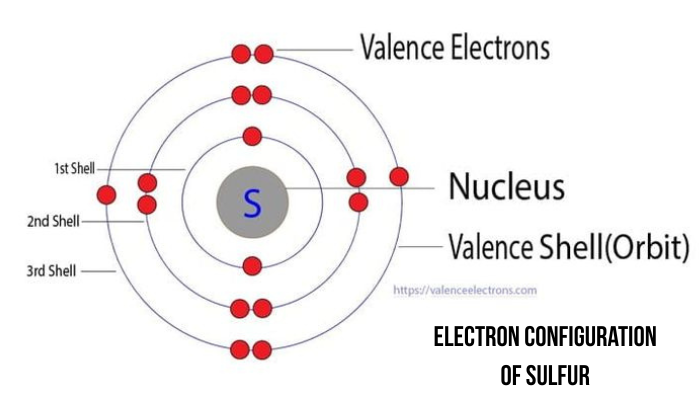
The complete electron configuration of sulfur is: 1s2 2s2 2p6 3s2 3p4
Let’s break this down step by step. The first two electrons go into the 1s orbital, filling it completely. These are the closest electrons to the nucleus and experience the strongest attraction. The next two electrons fill the 2s orbital. Then we place six electrons in the 2p orbitals, completing the second shell entirely.
Moving to the third shell, we place two electrons in the 3s orbital, and finally, we have four electrons remaining that go into the 3p orbitals. Those last four electrons in the 3p subshell are particularly important because they’re what chemists call the valence electrons. These are the electrons that participate in chemical bonding and determine how sulfur interacts with other elements.
The Noble Gas Shorthand Method
The noble gas shorthand method is a brilliant trick that chemists use all the time. Rather than writing out every single electron, you identify the nearest noble gas with fewer electrons than your target element. Neon, element 10, is that noble gas for sulfur.
Neon’s complete electron configuration is 1s2 2s2 2p6. Since sulfur has 16 electrons total, and neon accounts for 10 of them, we only need to write the remaining 6. Those 6 electrons are arranged as 3s2 3p4. So [Ne] 3s2 3p4 tells us everything we need to know about sulfur’s electron arrangement.
This method becomes increasingly valuable as you study heavier elements. Imagine trying to write out the complete configuration for an element like gold or uranium. It would take forever. The shorthand method keeps things manageable while maintaining complete accuracy.
Valence Electrons and Chemical Behavior
Sulfur has six valence electrons, and this number almost completely determines its chemical personality. Valence electrons are the outermost electrons, and they’re the ones doing the work when atoms bond with each other.
Because sulfur has six valence electrons and can hold a maximum of eight in its outermost shell, it needs two more electrons to complete this shell. This means sulfur tends to gain two electrons when bonding with other elements. When sulfur gains two electrons, it becomes the sulfide ion, written as S2 minus, and takes on a negative charge.
The six valence electrons also explain why sulfur can exhibit different oxidation states in various compounds. In some situations, sulfur might lose electrons or share them in different ways, creating compounds where sulfur displays oxidation states ranging from negative two to positive six. This versatility comes directly from having those six valence electrons available for interaction.
Electron Configuration Notation and Orbital Diagrams
Scientists use several different ways to represent electron configuration, and understanding each method helps you communicate more effectively in chemistry discussions.
The notation we’ve discussed (1s2 2s2 2p6 3s2 3p4) is called spectroscopic notation. Each number represents the shell, each letter represents the subshell type, and each superscript shows how many electrons occupy that subshell. This is the most common method you’ll encounter in textbooks and exams.
Electron dot structures, also called Lewis structures, show only the valence electrons as dots arranged around an element’s symbol. For sulfur, you’d draw the letter S and place six dots around it representing those six valence electrons. While less detailed than orbital diagrams, electron dot structures are incredibly useful for predicting bonding behavior.
Quantum Numbers and Electron Placement
Quantum numbers are the addressing system for electrons in atoms. Each electron’s location is specified by four quantum numbers that work together like coordinates.
The principal quantum number, represented by n, tells you which shell the electron occupies. For sulfur’s outermost electrons, n equals 3. The angular momentum quantum number, represented by l, describes the subshell type. Values of 0, 1, 2, and 3 represent s, p, d, and f subshells respectively. For sulfur’s valence electrons in the 3p subshell, l equals 1.
Practical Applications and Real World Importance
In pharmaceuticals, many medications contain sulfur. Understanding how sulfur’s electrons interact helps chemists design these molecules. Cancer drugs, antibiotics, and pain relievers all might contain sulfur atoms playing specific chemical roles determined by electron configuration.
Biological systems depend on sulfur too. Amino acids containing sulfur help form the three dimensional structures of proteins. Hair gets its strength partly from sulfur containing bonds. Without understanding electron configuration, chemists couldn’t have discovered these biological relationships or engineered the molecules that improve human health.
Materials science uses sulfur in lithium sulfur batteries, a promising technology for storing renewable energy. These batteries work because of how electrons move through sulfur compounds. As we transition to clean energy, understanding sulfur’s electron configuration becomes economically important.
Key Takeaways About Sulfur’s Electrons
Sulfur’s electron configuration reveals a lot about this versatile element. With 16 electrons arranged as 1s2 2s2 2p6 3s2 3p4, sulfur demonstrates predictable bonding behavior. The six valence electrons make sulfur eager to gain two more electrons, forming sulfide ions, or to share electrons with other atoms.
This arrangement places sulfur in group 16 of the periodic table, surrounded by other elements with similar electron configurations and chemical properties. Oxygen and selenium, sitting directly above and below sulfur, have analogous electron arrangements that create similar chemical personalities.
Read Also: Electron Configuration of Sulfur Explained